What cold actually affects
Three things change in cold weather, and only one of them is about our crew being uncomfortable.
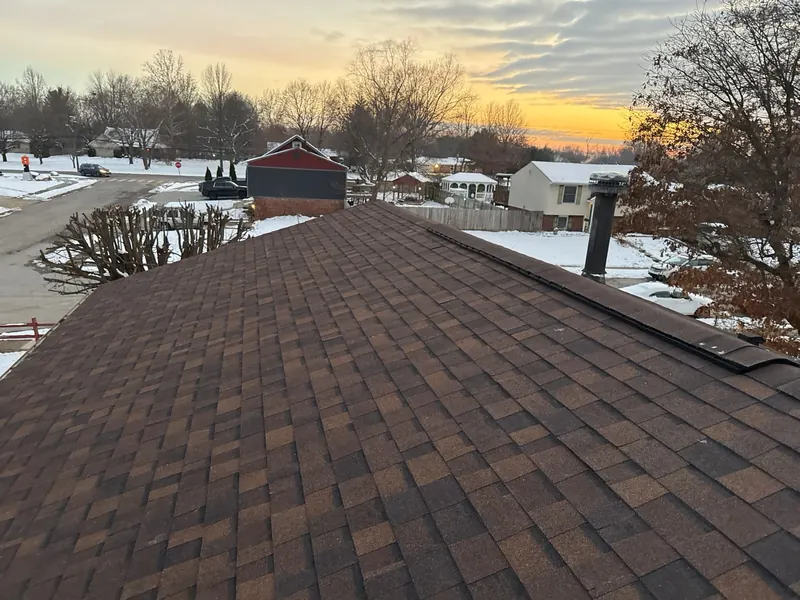
Shingles get stiffer. Asphalt shingles are flexible in warm weather and brittle in cold. A shingle that would bend in July can crack when it is handled roughly in January. That is a handling problem with a handling solution: keep bundles warm until they go up, carry fewer at a time, and cut with a fresh blade rather than forcing a fold.
The sealant strip needs heat to bond. This is the real one. Every architectural shingle has a strip of adhesive that is designed to soften in the sun and bond each course to the one below it. That bond is what makes the roof a wind-resistant surface rather than a stack of loose tabs. In cold weather the strip does not activate on its own, and it may not until the first genuinely warm stretch.
Nail depth gets less forgiving. Colder, stiffer material and colder decking make it easier to overdrive or underdrive fasteners, and a nail set wrong is a leak years later. It slows a careful crew down. It does not stop them.
What a crew does differently
The fix for the sealant strip is hand-sealing: placing roofing cement under the shingle tabs by hand so the course is bonded immediately rather than waiting on the weather. On a winter install that is not an upgrade, it is the standard, and it is the single biggest thing separating a winter roof that holds from one that loses shingles in a March windstorm.
The other adjustments are less visible. Bundles get stored somewhere warm and brought up in smaller batches. Nail guns get checked more often because pressure behaves differently in the cold. Ice and water shield needs a clean, dry, above-freezing surface to adhere properly, so the deck gets prepared rather than just swept.
Ask any contractor quoting you a winter roof whether they hand-seal. The answer tells you whether they have thought about it. It also has warranty consequences: TAMKO's limited wind warranty applies only if the shingles were installed to the application instructions and have had the opportunity to seal down, which our warranty page covers in full.
When we will tell you to wait
There are conditions where the right answer is to stop, and we would rather say so than take the job:
- Active snow, sleet, or freezing rain. Nothing goes on a wet deck
- Ice or frost on the roof surface, which is a genuine fall hazard before it is a quality problem
- Snow cover that has to be cleared first, which risks damaging what is underneath
- Sustained deep cold where the material is too brittle to handle without cracking
Indiana winters are not continuously severe. Most winters give us plenty of workable windows in the thirties and forties, and a full residential tear-off and reroof is normally a one to two day job, so we are usually scheduling around weather rather than fighting it.
When winter is actually the better time
Waiting is not free. A roof that is leaking in December keeps leaking through January, and water in the assembly does damage to decking and insulation that costs more than the delay saved. If your roof is actively failing, winter installation beats a wet attic.
There are practical advantages too. Roofing schedules are fuller in spring and fall, so winter lead times are often shorter. And if you are working an insurance claim, the claim has a deadline that does not care about the forecast, which our storm damage and insurance claims page covers in more detail.
Ice dams are a ventilation problem, not a roofing one
Every winter we get calls about ice building along the eaves and water backing up under the shingles. It is worth understanding that ice dams are not caused by the roof surface. They are caused by heat escaping from the living space into the attic, melting snow on the upper roof, which then refreezes at the cold overhang where there is no heat beneath it.
A new roof alone will not fix that. What fixes it is air sealing, adequate insulation, and balanced intake and exhaust ventilation so the attic stays close to outdoor temperature. Ice and water shield at the eaves protects the assembly when a dam forms, and it is standard on our installs, but it is a backstop rather than a cure. Our attic insulation and ventilation page is the relevant one if you are seeing this every year.
Emergency versus planned
These are different conversations. If a limb came through or shingles blew off and water is coming in right now, that is a call to make today, and the first step is usually a properly fastened tarp to stop the damage while we plan the permanent fix. Our roof repair and tarping page covers that. If nothing is leaking and you are simply planning ahead, winter is a fine time to get on a schedule and a good time to get an estimate without waiting behind the spring rush.